The Blind Spot · Mel · 28 October 2026
I'm 5ft. Who was my airbag tested on?
I fell over in a car park wearing a £540 airbag vest and it didn't inflate. I thought I'd done my research before buying it. Turns out there were a few questions I hadn't thought to ask.
Status: still digging
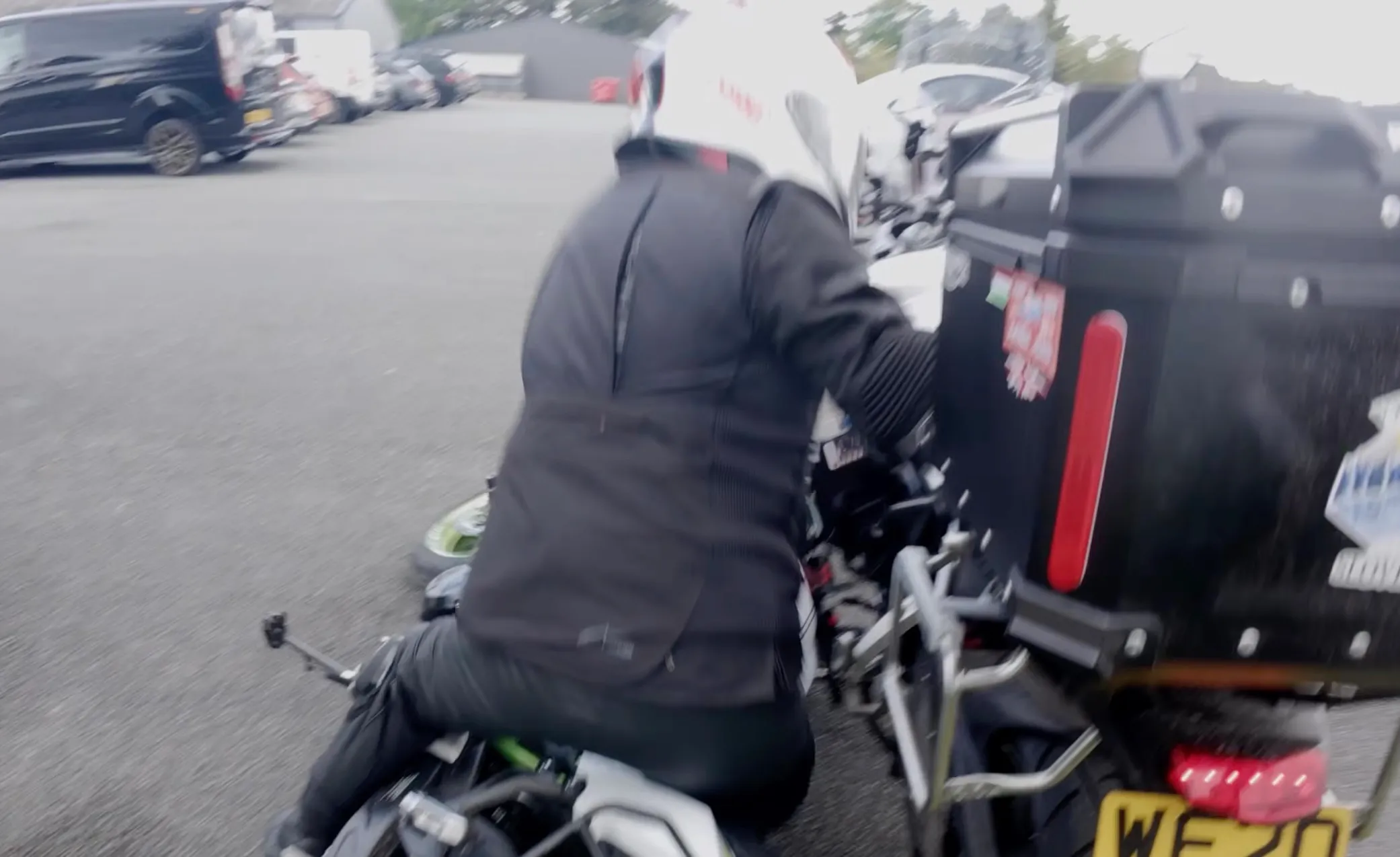
We have the fall on camera. I was wearing my Alpinestars airbag, it was switched on, and when I went over, nothing happened. No inflation. My first thought was that something must be wrong with it. This isn’t a “don’t buy an airbag” story. I still wear mine.
I want to ride for as long as possible
It was at Motorcycle Live last year, in 2025, that Glyn and I decided to invest in airbags. We’d been doing plenty of research, including an excellent comparison of airbag vests by Bennetts BikeSocial, who put a pile of them through their own lab tests rather than reading the labels. Some of those results worried me, and I’ll come back to them.
I’ve been riding for about a year. I know motorcycling carries risk. I’m not trying to make it go away, I’m trying to shave off what I reasonably can, because I’d like to be doing this for a very long time. I don’t wear the airbag every ride. It comes out for the longer trips. It gives me reassurance, not invincibility, and I know those are different things: feeling safer is personal, and it isn’t a test result.
We preferred an electronic system to a tethered one, and we went with Alpinestars partly because of the gas inflator. On the original Tech-Air 3 a fired vest went back to a service centre. On the V2 you drop a new inflator in at home for about £90. That mattered to me, because I’m the one more likely to use it. So: the women’s version, the Alpinestars Stella Tech-Air 3 V2, £540. “Anatomically profiled for a fully optimised female fit”, says the listing.
Now, me. I’m about 153 cm. I weigh around 50 kg, sometimes less. I’ve also got a pair of tits. None of that seemed relevant when I was handing over the card. I’d bought the women’s one, and I assumed a CE mark on a safety product meant somebody had checked it worked on bodies like mine. After the car park, I wanted to know what testing has actually been done, what it shows, and how much of it covers smaller riders and female anatomy. Here’s what I found.
It didn’t go off
It wasn’t a fault. The Tech-Air 3 manual has a section called the Envelope of Protection, and a fall at walking pace is outside it. Below 25 km/h, 15 mph, “the System may not deploy at the time of the collision/crash”. The warnings put it plainly: “in low speed/low energy crashes it is likely and reasonable that the System will not deploy”, and the reason is “to prevent wasteful use of the charges in situations where protection typically would not be needed.” Fine. I’d rather have been told at the till, but fine. The same manual says it will fire if you fall while dismounting, so a fall off the bike counts and a fall with it may not, and the line between the two is a number nobody publishes.
This is the industry, not one maker. In&motion, whose box runs the Klim, Furygan, Held, Ixon and RST vests, told Bennetts: “you might fall while at a standstill, without any danger around you; that doesn’t require any inflation.” Their release notes put the algorithm at 96% of falls detected by March 2025. Hélite’s electronic vest “only detects accidents from a speed above 20 km/h” unless you bolt a sensor to the forks. And the CE test never asks when the bag fires, only how it performs once it has.
So that’s why it didn’t go off. What the car park did was send me reading, because digging into numbers and what a claim actually rests on is what I do for a living, and I found this fascinating. The question turned out not to be about me being a woman. It was about anyone my size and height, bloke or not, and then about the bits of me that aren’t a bloke’s.
25 km/hBelow this, it may not fire.
157 cmThe smallest size. I'm 153.
0 of 7Makers I read who say how the chest bag sits on a woman.
76 to 88Ages of the bodies it was crash tested on. All male.
Built for whom?
Mine is the women’s version, the Stella, and its size table has one row the men’s doesn’t: bust. That, as far as I can find, is what a women’s airbag is across the industry: a different cut and a second tape measurement. Alpinestars sells the Stella on “tailored, tapered patterning”. Furygan’s new Lady vest, launched this month, is sold in the French press to “the slimmest silhouettes to the bustiest” while keeping “the strong points of the men’s model” (my translation). Nothing published says the bag inside differs. And the manual for Alpinestars’ dearer vest, the Tech-Air 5 Plasma, says its size chart is “references based on Men’s general sizes (without any discriminatory intention)”. Mine doesn’t say whose sizes it used.
I read every manual, FAQ, product page and press release I could find from Alpinestars, Dainese, In&motion, Hélite, Furygan, Held and Klim, looking for one sentence about where the chest bag sits on a woman, how it inflates over breast tissue, or whether it was shaped or tested for it. I didn’t find one. The only time any maker mentions breasts is to say no. This is in my vest’s manual, under Health and Age Restrictions:
“The System must not be used by women with artificial breast implants.”
Alpinestars, Tech-Air 3 user manual
Hélite says ask a doctor about “breast prosthesis”. Dainese, via its retailers, says “exercise caution”. Bennetts asked why, and the answer was that the risk “has not been evaluated”. Not finding something isn’t proof it was never done. It does mean that if the work exists, nobody thought I needed to see it.
I went through the patents too. Dainese’s, Alpinestars’, Honda’s: no woman in any of them. The only motorcycle airbag patent I could find that mentions a female rider is from a private inventor in 2009, with “two substantially triangular cut outs to adapt said air bag for a female rider”. On paper, a bloke with a sewing idea got further than any maker I could find.
What a chest does
Cars have started on this, so we know roughly what motorcycling hasn’t looked at. A 2026 Stapp paper from Ohio State and NHTSA hit female cadaver chests with an impactor: those with breasts “displayed lower peak force and greater peak deflection compared to those without breasts”. The tissue changes how the chest takes the hit, and the ribs travel further. Women’s ribs fail at lower bending loads, and women are at higher risk of rib and sternum fractures than men in a frontal crash. None of it was done with a motorcycle airbag. All of it says the chest bag may have a different job on a woman, and nobody I can find has checked.
Tested on a dome, then on dead men
The CE badge is EN 1621-4. The test drops a 5 kg kerbstone-edged striker at 50 joules onto the inflated bag, which is lying on a steel dome with a load cell under it. Level 1 lets under 4.5 kN through to the body, Level 2 under 2.5 kN: lower is better. My vest is Level 2 on the chest and the back. (The dearer Tech-Air 5 Plasma is Level 1 on the back and its chest isn’t certified at all.) No torso, no dummy. The standard’s scope says it covers “mechanically activated” vests, the ones with a cable, and Alpinestars’ Tech-Air 5 manual says it was used “with reference to impact performance and ergonomics only”.
Some vests carry a different badge: stars from SRA, the French insurers’ association, on a lab protocol that drops a flat disc onto a flat plate and scores trigger time. The results aren’t published, only the stars. This is where the Bennetts numbers that worried me come from. They put SRA-rated vests under the EN 1621-4 kerbstone striker, as an indicative test, not a certification: the Hélite Turtle 2 let 32 kN through at the chest and 2.5 kN at the back, where a certified Level 2 back is under 2.5 kN. Hélite’s founder answered that the dome is too narrow to stand for a body, and asked why anyone would make a €700 airbag if a €20 back protector can pass the airbag test. He has a point about the dome. Bennetts have a point about the chest. Two tests disagree, and neither of them puts the bag on anything shaped like a person. Glyn had been calling the French one made up. It isn’t. It’s a private label with a stopwatch; the European one has a kerbstone and no stopwatch.
Where researchers used a body, it was one body. Transport for New South Wales ran seven vests on a Hybrid III crash dummy this September: the 50th-percentile male, an average-sized man. The EU’s PIONEERS rig used the same dummy’s torso at 75 kg. Autoliv’s digital model is the 50th-percentile male. The one crash test I found with real bodies, four airbag jackets on cadavers in 2019, says of its subjects: “All were male, of normal corpulence and an advanced age.” Aged 76 to 88. When the FIM made airbags compulsory across circuit racing from 2022, sidecar passengers had to wait for tests “to determine whether the known algorithms are valid for passengers”. I couldn’t find that check published for women. The first project I found that says it will test with female subjects is Swedish, funded in June 2025, due in 2027.
One wrinkle. Alpinestars says its algorithm was “developed from years of research with over 50% of the world’s top MotoGP riders”. Those are small men: Dani Pedrosa raced at 160 cm and 51 kg. So the crash data may be closer to my size than Glyn’s, the dummy is closer to his, and the nearest thing to a car-park fall in any of it is a man dismounting.
Below the chart
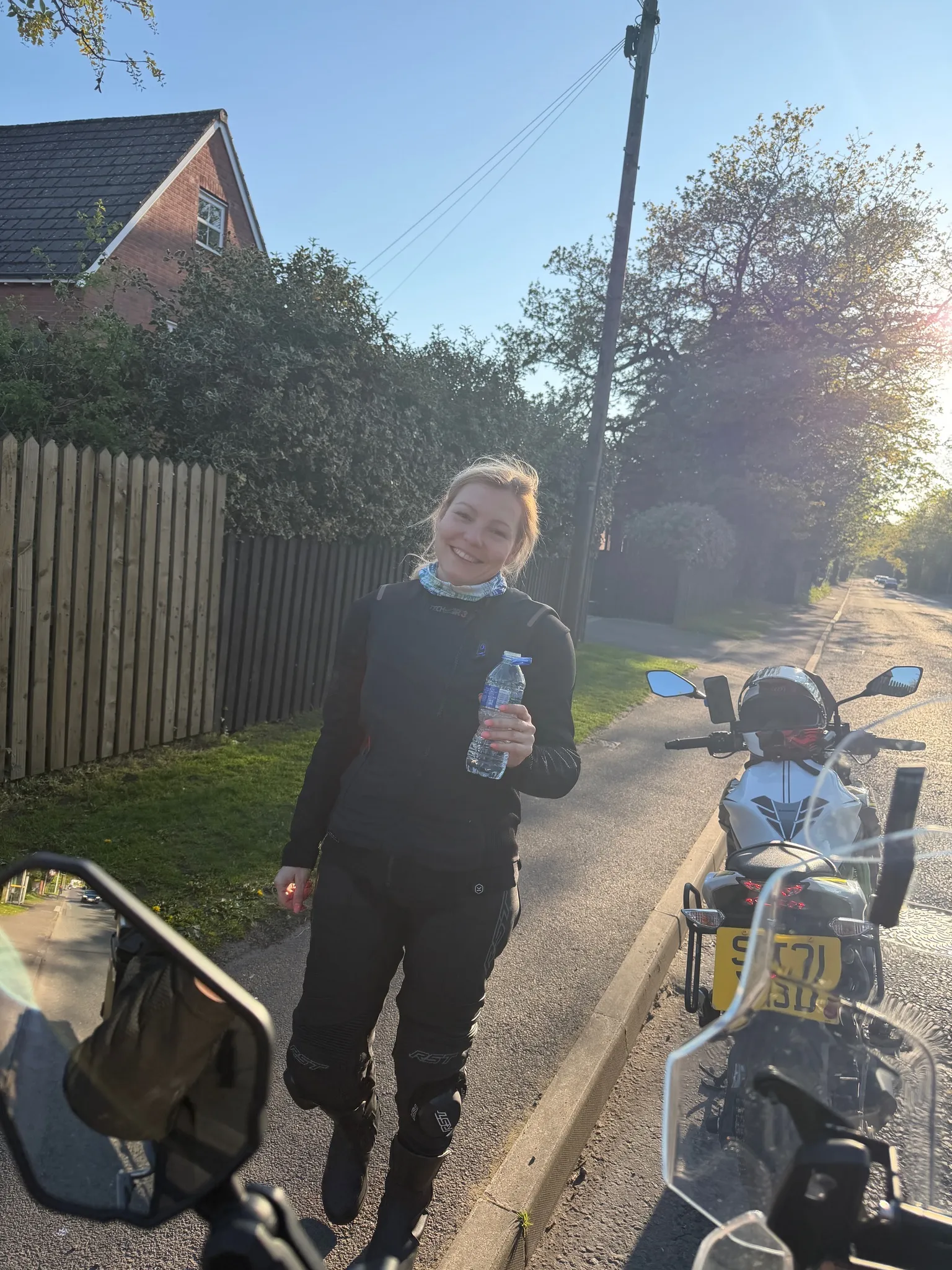
The manual sizes the vest by your waist-to-shoulder length and calls its height ranges “only for reference”. The Stella’s smallest row starts at 157 cm. I’m 153. The Tech-Air 5 Plasma starts at 163. The only chart I found that reaches me is Hélite’s e-Turtle, XS from 145 cm. There’s also a rule I can’t find a reason for: Tech-Air 3 “sizes smaller than size “S” must not in any case be worn under a protective outer riding garment”. So mine goes over the jacket, which is where you’ll see it in the roadside photo.
Sizing by torso length rather than height is deliberate: one protector maker’s manual says “no consistent relationship to the body height exists”. Fair. A small British woman sits about 11 cm shorter in the torso than an average man. Below the smallest row, nobody says where the back protector, the chest bag or the sensor box land. And I couldn’t find any electronic vest that publishes a rider weight. Hélite’s lanyard vest bans anyone under 35 kg; that’s the only weight I found in the industry. The sensors ride on the vest, and whether 50 kg going over reads the same as 95 kg is a question no manual answers.
More of us
Women passed 9.8% of motorcycle Module 2 tests in Great Britain in 2025/26, up 40% in ten years against 7% for men. One in ten riders passing today is a woman, buying a bag certified on a dome and researched on a male dummy.
What’s next
This page says “still digging” because The Blind Spot’s rule is to ask the makers in writing before calling anything settled. The letters are going to Alpinestars, Dainese and In&motion with three questions. Has the bag, not the cut, been tested on a female form, and can we see it? What is the smallest rider the vest is designed for, in centimetres and kilograms? Below what speed or energy will it not fire, as a number? We’ll print who answers and who doesn’t.
I’ll keep wearing it on the long trips. It makes me feel better, and I know that feeling isn’t evidence. If you’re a woman in an airbag, or a small bloke in one: what size were you sold, what were you told, and has it ever not gone off? That’s what the form below is for.
Where this came from
The Tech-Air 3 manual, the Tech-Air 5 Plasma manual, Alpinestars’ Stella Tech-Air 3 V2 page and 2020 launch release, the Stella listing, Bennetts’ airbag guide, Tech-Air 3 V2 review, Hélite test and In&motion review, In&motion’s release notes, Dainese’s FAQ, Hélite’s electronic and lanyard guides, Furygan’s launch in Motoplanete and Le Repaire, the patents (Alston 2009, Dainese, Alpinestars, Honda), the Stapp breast tissue paper, Kalra 2015 and Ranmal 2024 on ribs, EN 1621-4, SRA, the Transport for NSW report, the PIONEERS slides, the cadaver tests, the FIM, the Swedish project, Honda’s Pedrosa profile, a back protector manual on sizing, Pheasant’s tables, and the DVSA’s test table DRT221B. The full working is in our research notes.
Your say
Ever had one not go off?
Woman or small bloke in an airbag: what size were you sold, what were you told, and has it ever not fired? Tell us.